
Post
Best Home Theater Speaker Setups for Every Room Size and Budget
Jun
Best Home Theater Speaker Setups for Every Room Size and Budget
Introduction
Creating a home theater system is one of the most effective ways to elevate movie nights, gaming sessions, sports viewing, and music listening experiences. While modern televisions continue to improve in picture quality, their built-in speakers often struggle to deliver the immersive audio that blockbuster movies and high-definition content deserve. A well-designed home theater speaker setup can transform an ordinary room into a cinematic entertainment space with powerful sound, crystal-clear dialogue, and realistic surround effects.
The ideal home theater system depends on several factors, including room size, budget, listening preferences, and available space. Fortunately, there are excellent speaker configurations available for every situation, from compact apartment living rooms to dedicated home theater spaces. Whether you’re building your first surround sound system or upgrading an existing setup, understanding the different speaker arrangements can help you maximize performance and value.
This comprehensive guide explores the best home theater speaker setups for every room size and budget, helping you choose the right configuration for an exceptional entertainment experience.

Why a Dedicated Home Theater Speaker System Matters
Audio plays a critical role in creating immersion.
A great soundtrack, realistic sound effects, and clear dialogue bring movies and television shows to life.
Benefits of a Home Theater Speaker Setup
Enhanced Dialogue Clarity
Hear conversations clearly.
Immersive Surround Sound
Experience realistic environmental effects.
Powerful Bass Performance
Feel explosions and action scenes.
Greater Emotional Impact
Become more engaged with content.
A quality speaker system significantly improves overall entertainment.
Understanding Home Theater Speaker Configurations
Home theater systems are commonly described using a numerical format.
Examples
2.0 System
Two speakers, no subwoofer.
2.1 System
Two speakers plus one subwoofer.
3.1 System
Left, center, right speakers plus subwoofer.
5.1 System
Five speakers and one subwoofer.
7.1 System
Seven speakers and one subwoofer.
Dolby Atmos Systems
Include height channels for three-dimensional sound.
Understanding these formats helps simplify speaker selection.
Best Budget Setup: 2.0 Stereo System
For beginners and smaller budgets, a quality stereo pair can deliver impressive results.
Components
- Left speaker
- Right speaker
Advantages
Affordable
Lowest entry cost.
Simple Installation
Minimal wiring.
Improved Sound Quality
Far superior to TV speakers.
Music Versatility
Excellent for music playback.
A 2.0 setup is an excellent starting point.
Budget-Friendly Upgrade: 2.1 System
Adding a subwoofer dramatically enhances low-frequency performance.
Components
- Left speaker
- Right speaker
- Subwoofer
Benefits
Deeper Bass
Improve movie impact.
Better Music Performance
Enhance low-end detail.
Greater Immersion
Create a fuller sound experience.
Many users find a 2.1 system provides outstanding value.
Best Entry-Level Home Theater Setup: 3.1 System
Dialogue is often the most important aspect of movie sound.
A dedicated center channel improves speech clarity significantly.
Components
- Left speaker
- Center speaker
- Right speaker
- Subwoofer
Advantages
Clear Dialogue
Improve vocal reproduction.
Strong Front Soundstage
Enhance movie realism.
Moderate Cost
Excellent value for movie enthusiasts.
A 3.1 system is often considered the ideal first home theater upgrade.
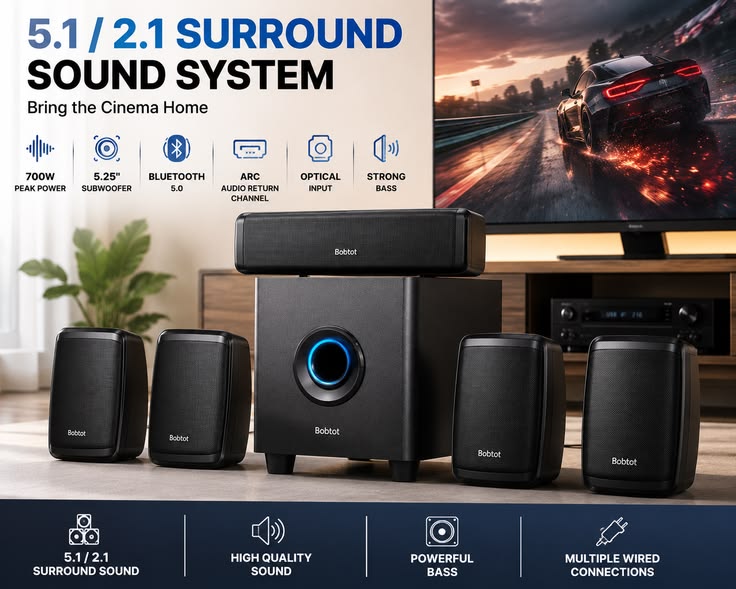
Best Overall Setup: 5.1 Surround Sound System
The 5.1 configuration remains the industry standard for home theaters.
Components
- Front left speaker
- Center speaker
- Front right speaker
- Surround left speaker
- Surround right speaker
- Subwoofer
Benefits
True Surround Sound
Experience directional audio.
Greater Immersion
Enhance realism.
Wide Content Support
Compatible with most media.
Balanced Performance
Excellent for movies and gaming.
For many households, a 5.1 system offers the best balance of performance and affordability.
Best Setup for Large Rooms: 7.1 Surround Sound
Larger spaces can benefit from additional surround speakers.
Components
- Five standard surround speakers
- Two rear surround speakers
- Subwoofer
Advantages
Expanded Sound Field
Improve room coverage.
Better Rear Effects
Enhance immersion.
Greater Precision
Improve sound placement.
A 7.1 system is ideal for larger entertainment rooms.
Premium Experience: Dolby Atmos Systems
Dolby Atmos adds height information to traditional surround sound.
Popular Configurations
5.1.2
Five speakers, one subwoofer, two height channels.
7.1.2
Seven speakers, one subwoofer, two height channels.
7.1.4
Seven speakers, one subwoofer, four height channels.

Benefits
Overhead Effects
Experience sound from above.
Three-Dimensional Audio
Increase realism.
Cinematic Immersion
Replicate commercial theaters.
Dolby Atmos represents one of the most significant advancements in home audio.
Best Speaker Choices for Small Rooms
Compact spaces require careful equipment selection.
Recommended Options
Bookshelf Speakers
Excellent balance of size and performance.
Compact Subwoofers
Save space while providing bass.
Wall-Mounted Speakers
Improve flexibility.
Avoid oversized systems that may overwhelm smaller rooms.
Best Speaker Choices for Medium Rooms
Medium-sized rooms offer greater flexibility.
Recommended Setups
3.1 Systems
Excellent value.
5.1 Systems
Balanced performance.
Compact Tower Speakers
Improve bass and dynamics.
Medium rooms can support a wide range of configurations.
Best Speaker Choices for Large Rooms
Large rooms demand greater output capability.
Recommended Equipment
Floorstanding Speakers
Deliver room-filling sound.
Multiple Subwoofers
Provide even bass distribution.
7.1 or Atmos Systems
Maximize immersion.
Proper scaling is essential for large spaces.
The Importance of a Center Channel Speaker
Many home theater enthusiasts consider the center speaker the most important component.
Benefits
Clear Dialogue
Improve speech intelligibility.
Better Front Imaging
Anchor on-screen action.
Consistent Performance
Maintain balance across seating positions.
A quality center channel dramatically improves movie enjoyment.
Why Subwoofers Matter
Subwoofers reproduce low-frequency effects.
Benefits
Deep Bass
Enhance action scenes.
Greater Impact
Increase realism.
Reduced Speaker Strain
Allow other speakers to focus on higher frequencies.
Even small systems benefit from subwoofer integration.
Wireless Home Theater Options
Modern home theaters increasingly support wireless technologies.
Advantages
Reduced Cable Clutter
Simplify installation.
Greater Flexibility
Improve room layouts.
Easy Expansion
Add components conveniently.
Wireless systems continue gaining popularity.
Choosing Speakers Based on Budget
Budget planning helps narrow options.
Entry-Level Budget
Focus on:
- 2.1 systems
- 3.1 systems
- Bookshelf speakers
Mid-Range Budget
Consider:
- Quality 5.1 systems
- Dedicated subwoofers
- Better amplification
Premium Budget
Explore:
- 7.1 systems
- Dolby Atmos
- High-end floorstanding speakers
Matching expectations to budget improves satisfaction.
Speaker Placement Tips
Proper placement greatly affects performance.
Front Speakers
Position at ear level.
Center Speaker
Align with the display.
Surround Speakers
Place slightly behind seating positions.
Subwoofer
Experiment with placement for optimal bass response.
Good placement maximizes system performance.
Common Home Theater Setup Mistakes
Avoid these common errors:
Ignoring Room Size
Choose speakers appropriate for the space.
Skipping the Center Channel
Dialogue quality suffers.
Underestimating the Subwoofer
Bass is essential.
Poor Speaker Placement
Reduces effectiveness.
Proper planning leads to better results.
Future Trends in Home Theater Audio
Home theater technology continues advancing rapidly.
Recent innovations include:
Dolby Atmos Expansion
Growing content support.
Wireless Surround Systems
Simplified installation.
Smart Home Integration
Voice-controlled operation.
AI-Based Room Calibration
Automatic optimization.
These technologies continue improving home entertainment.
Building the Ideal Home Theater System
The best system combines:
- Appropriate speaker configuration
- Quality amplification
- Proper placement
- Room optimization
- Reliable source components
Each element contributes to the final experience.
Conclusion
The best home theater speaker setup depends on your room size, budget, and entertainment goals. Small rooms may thrive with a compact 2.1 or 3.1 system, while medium-sized spaces often benefit from a versatile 5.1 surround sound setup. Larger rooms and dedicated theaters can take full advantage of 7.1 configurations and Dolby Atmos systems for truly immersive cinematic experiences.
By carefully considering room dimensions, speaker placement, budget constraints, and listening preferences, you can build a home theater system that delivers outstanding audio performance and transforms everyday entertainment into a captivating experience. Whether you’re watching movies, streaming shows, gaming, or listening to music, the right speaker setup ensures that every sound is heard with clarity, depth, and realism.
